Showing posts with label History. Show all posts

Tuesday, 11 October 2011

Tooraliaditty


Introduction

This is the story of a song.

A song I heard as a child in the late 1960s and early 1970s. But it is a song that made me wonder where Botany Bay was. 

As I was growing up before the Independence of Papua New Guinea, two places in the present day Australia called to my imagination. Melbourne, a place I could see on the map and Botany Bay a magical place in my imagination.

My elder sisters brought the song home and they would sing it at home. I had three elder sisters and I liked being with them as a child when they would start comparing the different songs that they were learning in school.

I used to be transported by that song and I couldn't wait to go to school myself and learn the song first hand. In many ways, I too wanted to be bound for Botany Bay. 

"Botany Bay" was a song that neither "Waltzing Matilda" nor "This Old Man" could rival in my childhood taste for beautiful songs.

By the time I entered prep in 1970, I kept listening out in the various classes to see which teacher was teaching "Botany Bay". But it seems that I had come in to school too late. For suddenly, it seemed that one part of history would be denied to me. After my own school day, which at the time for preps ended at 12 mid day, I would wait around outside various classrooms, listening for the song. But I never heard it in school ever.

The elder children's class rooms especially around the grade four classrooms, in 1970 were singing "This old man" before they would break for lunch. But I kept listening out for Botany Bay.

We must have had some Irish Australian teachers in Rabaul in those days. Because there was another Irish lullaby that I had heard: "Too-ra-loo-ra-loo-ra" 

I never really cared much for the meaning of the words of "Botany Bay" nor did I stop to ponder what must have been the heart breaking conditions that inspired a poet or musician to compose the song.

Today, it can be amazing to wonder: Was this really a song written for entertainment? How could that be, when one human's suffering could be another's pleasure? Yet, when we look at theatrical entertainment over the years, it is such that "Les Miserables" do make for the best figurants or stooges of stage and screen.

But as a child, I was in awe of the song's somehow, liberating refrain. There was something in it that even a child could sense. Something melancholic but something also healing. Something that made even a child go looking. Reaching out. Breathing the air for the meaning of song.

Singing too-ral, li-ooral, li-addity,
Singing too-ral, li-ooral, li-ay,
Singing too-ral, li-ooral, li-addity,
And we're bound for Botany Bay.

I should also explain that "To Ura Lai" in my own language means, two mates or two friends. A familiar term we use to address a brother in law. As inlaws in my culture are addressed in the plural. "Tolai" (my friend) the name my people are known by in PNG, is in fact the singular form of "To Ura Lai" the polite form. It is quite normal for a man in joy or even distress to call out to his "Ura Lai" in various intonations.

Children of my generation, when we were in pain, or if we were punished, or hurt, we would cry out:

"Ooh yau kalalai, yau kalalai titi".

These words have no translatable meaning in the Kuanua language. It is just a long exclamation of a child's fear and anticipation.

Children would chant those lines when they were beaten as was the common practice of the time. As we were called to a beating punishment, we would start chanting that song and sing it as long as we could manage to pronouce it. Then when the pain of the beating became too much, then we would lose the power of speech. We would stop that chanting and switch to "Oui Iau Kamuka, Iau Kamuka", which we would utter at every stroke. Curiously, although this translates to the "Mea Culpa" in latin, we did not shout them to admit guilt. We wanted to speak and prolong the time between strokes. Survival instincts. Children just learnt it from one another and practiced it.

It was almost by a curious onomatopoeic echo, that the song had come to me. Of course I knew it had other meanings but first impressions are first impressions. And in my traditional musical culture there is a whole genre of songs that are called "Li-li". Li-li is synonymous with "song" for which other words in the language are: "kakailai", and "liu" etc.

But as I grew older, I started to realise the meaning of the song. I begain to realise the plight of people who had been sent away from home. And one part of me wanted to know why this was necessary. That's when the song again echoed with traditional myths and legends that I had heard as a child.

So there were some convicts? Some criminals? What kind of criminals? 

  • Poachers - people who were just hunting animals like I am allowed to do in PNG
  • People who destroyed crops - they must have been hungry and they probably took some food from farms
  • Political Protestors - people protesting against low wages

These were criminals?

As I grew older I began to hear "Botany Bay" differently. How could a criminal be so homesick? Why this pain from someone "evil" and condemned?

International Events Leading to Transportation

Although the transportation of convicts to Australia was caused by the American Revolution and War of Independence, which denied Great Britain a previous location of transporting its prisoners, it seems that the main reason for the mass transportation of prisoners to Australia was the looming threat of invasion of Great Britain by the French especially Napoleon, during the time of wars in Europe around 1790.

Perhaps for a protestant monarchy in Great Britain, the threat of a French (Catholic) invasion was too great to face. Any civil unrest at home had to be eliminated efficiently and the best solution that the monarchy could do was to remove any elements of society that might weaken its resolve from within. 

It is not surprising that many of the transported criminals from the gaols and the hulks were of Irish descent. It is said that 9 out of every 10 prisoners in the Irish gaols were catholic. 

As the monarchies in the surrounding countries in Europe prepared for war, a war eventually known as the Napoleonic Wars, and primarily intended to restore the monarchy in France, following the French Revolution, the transportation of rebels, protestors and criminals to Botany Bay became underway before the total outbreak of that particular series of wars.

Botany Bay

Somewhere during that period of constant war in Europe, people found themselves being condemned and transported from their homes and loved ones. It was that traumatic period and condition that gave birth to this song.

Here is "Botany Bay" heard again, this time through the very beautiful voice of Mirusia Louwerse.

Sunday, 9 October 2011

Cold Chisel - Farewell to Steve Prestwich

Tribute to Steve Prestwich. RIP

With the passing of Steve Prestwich in January 2011, I wanted to pay a brief revisit to his band, my most favourite Australian Band, Cold Chisel and to the songs they played which stirred the hearts of workers and ordinary citizens of Australia, New Zealand and even Papua New Guinea. Among other songs, Steve Prestwich wrote the song "When the war is over" which is presented in this tribute.

Part of the tribute seeks to evoke the spirit that gave rise to the song writing of Steve Prestwich and also to Don Walker. We will do that by providing links to the subject and issues that they wrote and sang about.


Band members

Wondering about Cold Chisel's talent and the reason this Australian band broke as they did onto the international scene at the time they did, one has to consider their feat in respect to the moment. Cold Chisel appeared during an era which was actually the beginning of the end of hard working, live, stage performing rock bands. Pre-programmed music was already on the rise and disco music was about to pay its short visit onto the international music scene. It is interesting therefore to see Cold Chisel, whom I consider, the last of the great classical rock bands of the era, make its appearance and stamp its mark on the history of Rock and Roll.

It had great material in its composition of versatile band members, two of whom were great hit writing song writers, an incredibly talented lead guitarist, two great and complementary vocalists and a solid bass guitarist who could support any action. Certainly a keyboard virtuoso like Don Walker, who is also a songwriter, gave himself through his own talent, what every writer needs, a very quick play back about musical ideas and concepts. Then, Cold Chisel also had Steve Prestwich, a drummer who could hear music, conceptualised through various musical backgrounds, beats and temporal situations.

Many people talk of the great all around talent of Ian Moss. But at that exact point in the Rock and Roll and Heavy Metal Scene, it was that phenomenal voice of Jimmy Barnes that could cut across all the multiple frequencies of a live Rock and Roll performance and deliver crystal sobriety and passion. And there is no one alive today who will ever be able to touch the vocal notes that Jimmy Barnes owned with his vocal performances.  


Steve Prestwich is said to have written "When the war is over" in 1981. There is a good description of the song's structure over at Wikipedia which describes how it broke away from traditional song writing culture.

Here is a song, that truly captures a soldier's need to maintain his soul and dignity, in spite of all the destruction that he is made to commit on the face of the earth. This is the most beautiful anthem to a soldiers cry for his own freedom.

A soldiers dream perhaps best summed up in a single line of the whole song: "I got plans for more than a wanted man".

Ian Moss, certainly displayed his own genius when he led this song's performance to the crescendo building moments when the band's usual lead singer Jimmy Barnes starts to break in, and then joins Moss in a wonderful duet ending. One of the greatest songs of all time.

When The War Is Over lyrics: (Presented here in the original structure)


Ain't nobody gonna steal this heart away

When the war is over
Got to get away
Pack my bag to no place
In no time no day
You and I we used each other's shoulder
Still so young but somehow so much older
How can I go home and not get
Blown away

You and I had our sights set
On something
Hope this doesn't mean our days are numbered
I got plans for more than a wanted man
All around this chaos and madness
Can't help feeling nothing more than sadness
Only choice to face it the best I can

When the war is over
Got to start again
Try to hold a trace of what it was
Back then
You and I we sent each other stories
Just a page I'm lost in all its glory
How can I go home and not get blown away

Ain't nobody gonna steal this heart away

Ain't nobody gonna steal this heart away
-----------------------------------------------------------------
Four Walls


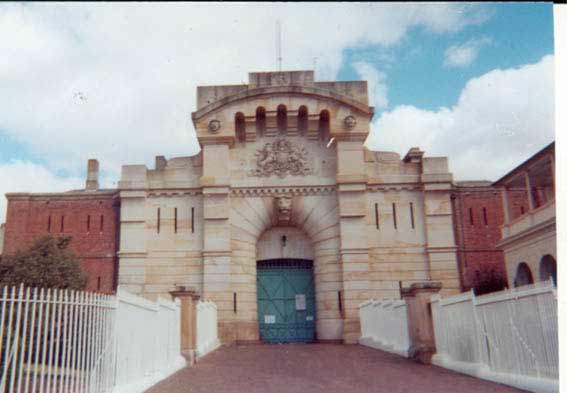
There's a long history of corruption and injustice around the Bathurst Prison and many events that mar its history. We won't go into the history incuding the social protests and police brutality that went on in Australia during the 70s and 80s. But through the lyrics of this song, we can explore some elements that would have fired the writing soul of this, what many consider to be the most successful Australian Rock Band ever. 

Cold Chisel's "Four Walls" may have played a big part in the public demand for the improvement of jail conditions and facilities in Australia.

Four Walls Lyrics: (Song Written by Don Walker)

They're calling time for exercise
The maid'll hose the room out
When I'm gone
I never knew such luxury
Before my verdict fell


And in every congregation
There was silence
You can hear the Angels singin'
When Christmas comes around
Four walls, washbasin, prison bed

I love to march while some Nazi calls the time
Who'd wanna go home

I can't see
I can't hear
They've burnt out all the feeling
I've never been so crazy
And it's just my second year
Four walls, washbasin, prison bed

-----------------------------------------------------------------
Khe Sanh

Many countries including Papua New Guinea, do not take notice of the post traumatic stress disorder suffered by soldiers returning from war. "Khe Sanh through the portrait of a lost and suffering soldier helped to bring this condition to public attention.
Khe Sanh Lyrics: (Song Written by Don Walker)

I left my heart to the sappers round Khe Sanh
And my soul was sold with my cigarettes to the blackmarket man
I've had the Vietnam cold turkey
From the ocean to the Silver City
And it's only other vets could understand

About the long forgotten dockside guarantees
How there were no V-dayheroes in 1973
How we sailed into Sydney Harbour
Saw an old friend but couldn't kiss her
She was lined, and I was home to the lucky land

And she was like so many more from that time on
Their lives were all so empty, till they found their chosen one
And their legs were often open
But their minds were always closed
And their hearts were held in fast suburban chains
And the legal pads were yellow, hours long, paypacket lean
And the telex writers clattered where the gunships once had been
But the car parks made me jumpy
And I never stopped the dreams
Or the growing need for speed and novacaine

So I worked across the country end to end
Tried to find a place to settle down, where my mixed up life could mend
Held a job on an oil-rig
Flying choppers when I could
But the nightlife nearly drove me round the bend

And I've travelled round the world from year to year
And each one found me aimless, one more year the more for wear
And I've been back to South East Asia
But the answer sure ain't there
But I'm drifting north, to check things out again

You know the last plane out of Sydney's almost gone
Only seven flying hours, and I'll be landing in Hong Kong
There ain't nothing like the kisses
From a jaded Chinese princess
I'm gonna hit some Hong Kong mattress all night long

Well the last plane out of Sydney's almost gone
Yeah the last plane out of Sydney's almost gone
And it's really got me worried
I'm goin' nowhere and I'm in a hurry
And the last plane out of Sydney's almost gone

-----------------------------------------------------------------
I was not sure which song to close this blog post with. So many great songs that remind me of growing up as a teen-age fan of Cold Chisel in PNG.

My Baby, Choir Girl, Rising Sun, Saturday Night, Ita, Working Class Man, Cheap wine, The last wave of summer, Forever Now..?

I'll settle today for "Flame Trees". Happy Listening..!


Flame Trees Lyrics
Song Written by Steve Prestwich and Don Walker

Kids out driving Saturday afternoon just pass me by
I'm just savouring familiar sights
We shared some history, this town and I
And I can't stop that long forgotton feeling of her
Time to book a room and stay tonight.


Number one is to find some friends to say "You're doing wel..."
After all this time you boys look just the same."
Number two is the happy hour at one of two hotels,
And settle in to play "Do you remember so and so?".
Number three is never say her name.


Oh the flame trees will blind the weary driver
And there's nothing else could set fire to this town
There's no change, there's no pace,
Everything within its place
Just makes it harder to believe that she won't be around.


But Oh! Who needs that sentimental bullshit, anyway?
You know it takes more than just a memory to make me cry
And I'm happy just to sit here, at a table with old friends
And see which one of us can tell the biggest lies.


And there's a girl, she's falling in love, near where the pianola stands..
With a young local factory auto-worker, just holding hands
And I'm wondering if he'll go or if he'll stay.


Do you remember, nothing stopped us on the field in our day


Oh the flame trees will blind the weary driver
and there's nothing else could set fire to this town.
There's no change, there's no pace,
Everything within its place
Just makes it harder to believe that she won't be around.


Oh the flame trees will blind the weary driver
and there's nothing else could set fire to this town.
There's no change, there's no pace,
Everything within its place
Just makes it harder to believe that she won't be around.

Tuesday, 12 July 2011

Globalisation Timeline 1940 - 2011

Traditional symbol of infinity, origins and destinations
from the Gazelle Peninsular, Papua New Guinea.


1 9 4 0 
1 9 4 4 
  • Bretton  Woods  Agreements  create  World  Bank  and  Monetary  Fund  General Agreement  on  Tariffs  and  Trade  (GATT)  established  to  negotiate  rules  for trade  in  goods - Roots of WTO


1 9 4 5 
  • United  Nations  Charter  signed
  • Dismantling of colonial empires creates independent  states in Asia and Africa and neocolonial economic relationships 
1 9 4 7
  • Cold  War  begins  pitting  capitalism  against  communism 
1 9 4 8 
  • Universal Declaration of Human Rights drafted 
  • World Council of Churches founded


1 9 5 8 
1 9 7 1 
1 9 7 0 s   
1 9 7 5 
  • Advances in computers, fiber optics, satellites, and  miniaturized  electronics radically alter production and distribution of goods and  services and patterns of global investment
1 9 8 0 
1 9 8 2 
  • Mexico tells creditors it is unable to pay its debts and the Third World Debt Crisis begins all around the globe as nations are unable  to pay escalating debts incurred during the 1970s
1 9 8 5 
  • During the UN Third World Conference on Women, women  activists from developing countries detail how neoliberal economic  policies exploit and hurt women
1 9 8 6 
  • World  Bank  and  International  Monetary  Fund  initiate  structural  adjustment policies  in  developing  countries  that  promote  trade  liberalization
1 9 8 7 
  • Canadian groups organize opposition to proposed free trade  agreement 
  • Free Trade Agreement (FTA) between Canada and U.S. 
  • D.C. District Court eliminates the “fairness doctrine” which outlined the responsibilities of radio and TV owners as public  trustees
1 9 8 8
  • Free  Trade  Agreement  (FTA)  signed  between  the  U.S.  and  Canada
1 9 8 9 
  • Fall of the Berlin Wall ends Cold War leaving capitalism as single dominant economic system; Transnational Corporations  (TNCs) enter former Soviet bloc countries in a push toward privatization

1 9 9 0 s 
1 9 9 0 s 


1 9 9 1 

  • Worldwide Web created, enabling instant communications around the globe

1 9 9 2 
  • North  America  Free  Trade  Agreement  (NAFTA)  between  U.S.,  Canada,  and Mexico  signed  with  side  agreements  on  labor  and  the  environment,  and  in the  face  of  intense  resistance  from  labor,  women,  environmental,  and  church groups  in  all  three  countries 
  • Maastricht  Treaty  creates  the  European  Union  solidifying  economic  and political  ties  between,  and  expanding  number  of,  European  nations  west and  east
1 9 9 4
1 9 9 5 
1 9 9 6 
1 9 9 7 
1 9 9 9 
  • 50,000 activists in Seattle protest WTO policies in the first of an ongoing series of activist protests of WTO policies at WTO meetings
  • U.S. TNCs use illegal accounting techniques to prop up failing profits; Enron, WorldCom, and others collapse in scandal 


1 9 9 0s - (new trends manifested from the end of the 90s onwards) 
2 0 0 0 
  • Churches, NGOs, activists mobilize around the world on the 50th  anniversary of the World Bank and IMF to call for a “Jubilee” cancellation of Third World debts
  • Wealthy  countries  agree  to  partial  debt  relief  with  terms  of  more  privatization and free trade
  • World leaders gather for UN Millennium Summit, committing to the eradication of extreme poverty and other global social goals by 2015

2 0 0 1 
2 0 0 2 


2 0 0 3 


2 0 0 5 
2 0 0 6 
Rulings on Oregon's Assisted Suicide Law • Wetlands ProtectionWhistleblowers • Warrantless Searches • Guantanamo Military Tribunals

Darfur • Afghanistan • Iraq • Sri Lanka

  • Coups In 2006, coups took place in Thailand and Fiji
  • Oaxaca, Rebellions begin in Mexico - Teachers Protest Against Economic Conditions in the state of Oaxaca
2 0 0 7 

2 0 0 8 


2 0 0 9 


2 0 10 


2 0 11 
  • Europe tries a final rally against the rise of new economic powers from Asia on the Global Economic scene.
  • Following the failure of the Deutsche Bank in America, and the bailout of US and European banks by the US Federal Bank, Europe is forced to clamp down on Greece in an attempt to make citizens work off or pay off, the debts of the major banks.
  • Deepening of privatisation policies culminate in the event of the Greek citizens becoming the first people to lose their public domain to the financial elite and their banks.  

What are we on about?
Global Political, Economic, and Social Facts. 
----------------------------------------------------------
This Globalisation Timeline is a work in progress and is incomplete, lacking many crucial pieces of the puzzle of contradictions, inconsistencies and the overall mismanagement of the planet. It also still lacks details that can clearly show the numerous counter measures that socially conscientious organisations and governments have tried to implement in attempts to stem the tide of the destruction of the planet's various independent systems of human survival.


We shall be seeking to gather other crucial elements of the total picture of what is now recognised as predatory capitalism and also to remove links that are proven to be "off the mark" with regard to this pursuit.


The effort here is to try to build a picture of international diplomatic and bilateral policies and counter policies that are concerned with the prevention of or the gradual loss of the public domain by citizens of the earth.


I hope that presenting a timeline in this manner, may help ordinary observers in Papua New Guinea like myself, to be able to form a close to informed perspective on the nature and main movement of the beast we call "predatory capitalism" - thus forming a common basis for observing international trends together where we may be  able to take care of the plight of our region in a concerted manner.


The compiler of this timeline is neither an historian nor an economist.


The skeleton timeline was taken from the website of the Western North Carolina Conference of United Methodist Women.

I accepted 1940 as the starting point for the timeline for practical reasons, so that we would not have to consider for instance Columbus in South America, and the whole and often painful, colonial histories that the third world has endured due to its inferior technology at the time of the first contact meetings. Those events have taken place and we live in a world which is the by-product of a combination and culmination of those events and their long lasting philosophies and effects.

This timeline is being reworked towards becoming customised for Papua New Guinean awareness and approaches to addressing local and global issues.

Thanks for your patience and suggestions on areas of the timeline that we need to work on.

Tuesday, 14 June 2011

Rereading the History of Papua New Guinea

Introduction:

This blog entry was prompted by Malum Nalu's blog post about Australia's first World War I battle, which took place on the Gazelle Peninsular in September 1914.

That article prompted me to think about how we as Papua New Guineans should perceive our own history.

Papua New Guinea today is struggling with many issues that trouble its nationhood. Some issues like corruption at the highest levels of its administration are real and the people must insist on the addressing of these matters.

On top of that our country seems to be hassled and haunted from all sides by a plethora of demands from visitors, residents, service users, corporate investors and exploiters, and from our own citizens about the state of Papua New Guinea's infrastructure, health and social services, law and order and security issues and amenities. Most of these demands regarding the performance of our country are real and the country should find a systematic method towards some solutions and establish the kind of sustainable practices that keep addressing the long list of existing and emerging issues.

But there are some disempowering and unsettling ideas that are baseless, like the common allegation that somewhere in its history, Papua New Guinea has become so mismanaged that it has failed the "Pax Australiana". This alleged failure to uphold the so called "Pax Australiana" is constantly echoed by many members of the expatriate community and in recent times even by some Papua New Guineans themselves. What exactly was the Pax Australiana? What was its philosophy? What were its programmes and how come it was not there as a founding document that the founding fathers of our nation could have used as part of the architecture of the modern Papua New Guinea?

Melanesian Ideals and War Memorials:


Should the modern Papua New Guinea be celebrating war like our Australian friends after what we have done on Bougainville?

What do we feel now as a Melanesian people of Papua New Guinea and what do we think about our part in modern war history? 

The modern culture of Australia seems a little preoccupied at the moment with war history, war memorials and war heroes. But there are some troubles that follow war around and which may enter our region like the present refugee problem that Australia is facing.

On the refugee problem, it seems acceptable to most of our citizens that we would support and be helpful to Australia with these emerging problems. We know that the Manus Province has always offered to help. But at the same time, how should Papua New Guinea itself come to terms with the situation of the refugees as a humanitarian issue? How does Papua New Guinea take on the problem of helping Australia deal with the refugee problem according to the moral and ethical senses we feel as Melanesian people? It is these kinds of questions and reflections that if faced and processed together as a nation of people may help the modern Papua New Guinea become better aware of itself as a thinking organisation.

Fallen Soldiers

Amongst the "about" 30 natives killed in that WWI battle in September 1914, when the Australians attacked the Gazelle Peninsular, were Tolai men, members of the German civilian police force in the thriving German New Guinea.

It seems that these were the second lot of Papua New Guineans to fall in war during an international conflict.

The first Papua New Guineans to fall as soldiers in an international conflict seem to have fallen earlier, in German Africa in the late 1800s, before any of the world wars. There are some very thin threads as leads to that story which could be an interesting little chapter of our history. But these stories need better verification as to the part any natives from German New Guinea played in Germany's colonial history.

Part of the search for our own Papua New Guinean boys, lost on foreign soil may lead us to some German graves in German pre World Wars Africa, where our boys may be buried. 

But were our fallen boys buried properly when they fell in Africa? Considering the 1800s history, and the perceptions of the humanity of the black races and the slavery of black people at the time, this is probably not the case.

This was the period towards the end of the era of slavery in Africa, where the Germans as late comers to empire building appeared more enthusiastic about slavery than the traditional empire builders of the time.


But what were our boys doing in German Africa? German East Africa includes what is now Burundi, Rwanda and Tanganyika (the mainland part of present Tanzania). 


The Defeated Army of the New Guinea Islands.

Part of the German Native Constabulary based on Gazelle Peninsular

Part of the German Native Constabulary that was based in Kieta,
German Solomons, now Bougainville.


A Snapshot of German New Guinea

At the time of the Australian take over, the capital of German New Guinea Rabaul:

... "was not so much a town as a tropical garden, dotted about with government offices, business premises, and bugalows. The avenues were carefully laid out and planted with poinciana and casuarina trees, the later creating the feeling, as one visitor many years later was to describe it, of looking down the nave of a cathedral half a mile long (Bertie, 1937: 46)." 
-from the book "Matupit" by A. L Epstein.


The Australian expropriation of German New Guinea and the new problems that the locals faced dealing with their new colonial masters were presented favourably to the public back in Australia. The military victory and take over in New Britain and Bougainville (German Solomons) was depicted in a cartoon in an Australian newspaper in December of 1914. 


Notice that the native soldier is already wearing a Digger hat and in the cartoon's caption, he is referred to in the derogatory term of "The Black-Birds". At this time, Pacific Islanders were still working as slaves in the sugar cane fields of Queensland. Some 55,000 to 62,500 South Sea Islanders were taken to Australia as slaves during the Black-Birding days.

Note: Readers may wish to pursue the history of the expropriation of German New Guinea for themselves. Some micro nationalist and "break-away" movements followed that chapter including the rise of the Mungkas Assosciation on Bougainville and the rise of the Mataungan Association on the Gazelle Peninsular.

Things seemed to have gone downhill for German New Guinea from then on.

Epstein found that there was a perceived deterioration of the administration and state of the former German colony.

"The Australian Military Occupation, which lasted until 1921, brought few changes to the area in the way of Administrative policy or economic organisation. The administration was, from its very nature, a caretaker administration, whose main concern became to maintain and increase the value of already existing European economic enterprises in the hope that victory would place them under Australian control (Rowley, 1958: 47)."

"Despite the many signs of neglect, Rabaul remained physically very much as the Germans had left it".

Epstein quotes an interesting letter printed in the Rabaul Times from a Rabaul resident:

"Why has the Botanic Gardens been neglected? ... It is to be hoped that some effort will be made at least to restore them to what they were when Germany lost Rabaul (Rabaul Times, 26.10.1928)".

Law and Order

It seems that the first thing that preoccupied the Australians when they took over was the now famous: "Law and Order Problem".

Epstein:

"It was however, the 'native question', or the 'Black Peril' as it was sometimes called locally, which appears to have preoccupied many of the white residents of Rabaul at this time. Frequent complaints were made about official laxity in administering the laws that purported to control native movements and behaviour, and a contrast was drawn between the contemporary 'disregard of all control and authority, the laziness and insolence, an even open scorn displayed' by the natives towards their white masters and the 'ingrained respect and obedience shown to their previous controllers' under the German régime. (Rabaul Times, 3.7.1925)."


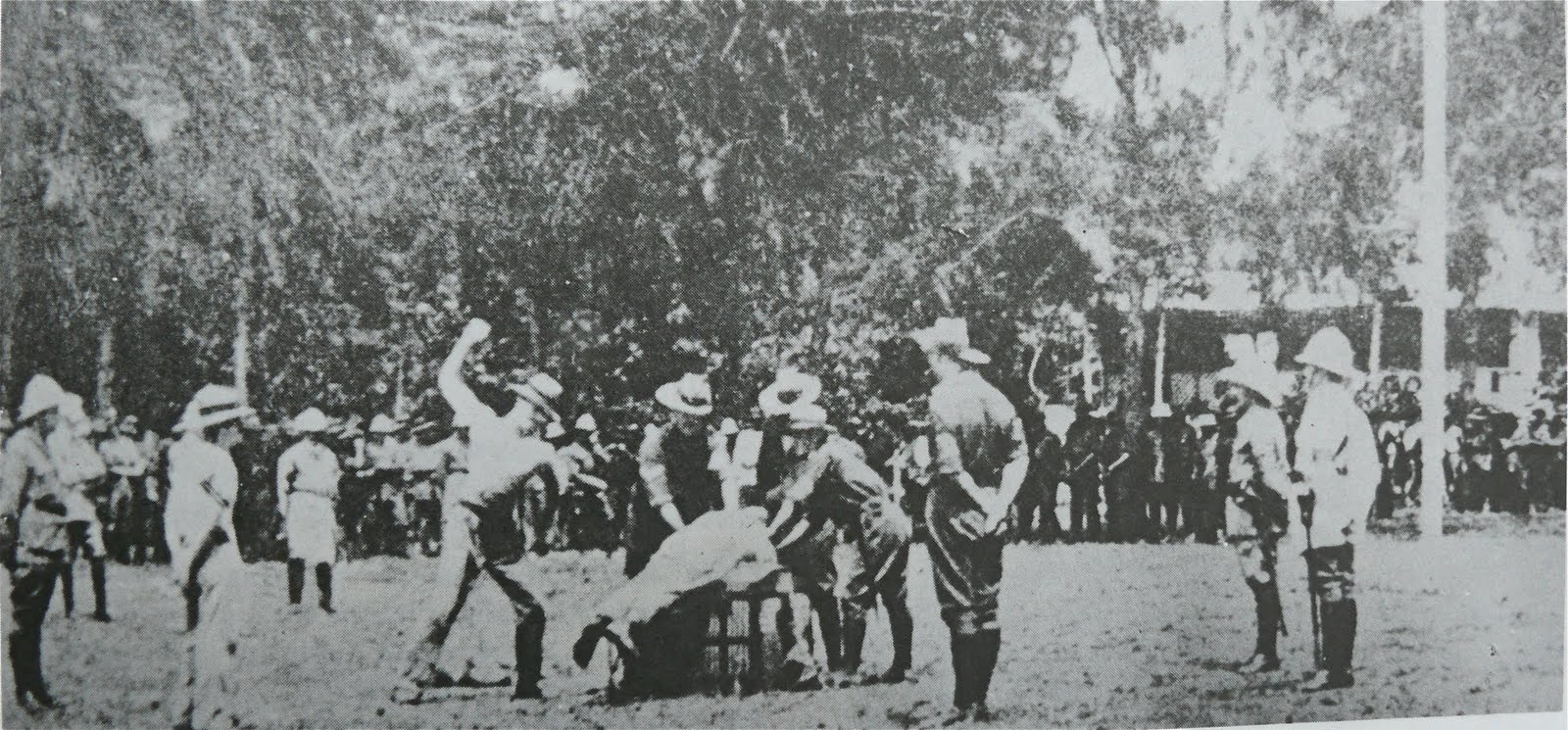
The Australian frustration with their own lack of control, could be manifested on two fronts. On one front, there seemed to be the need to humiliate the former German colonial masters in front of the natives, seemingly to show everyone who the real masters were. On the other front they needed to command the obedience if not the respect and admiration of the natives.

To do that, Germans who broke the law under the new Australian administration were caned in public in front of assembled natives and white residents. The image below shows the public whipping of a German doctor who had assaulted the Methodist missionary Rev. W. H. Cox. This incident happened in November 1914 two months after the Australian take over of German New Guinea.


Tensions between Germans and British at this time could also be attributed to Christian ideological differences and the missions' own competition and grabbing of real estate and congregation. Many Germans in Rabaul and New Ireland were part of the Roman Catholic Mission while the British were Methodists. So it seems that the Methodist church was also able to use the change over of regime to enlist the new military power for its own interests. This kind of religious tension between the "Popies" (derogatory term used in New Britain) and the Methodists went on in New Britain, until the independence of Papua New Guinea.

The natives themselves continued to be whipped or flogged as a matter of course. That was the general way the Australian masters related to the natives who were their labourers and domestic servants. 


Luluais and Tultuls

The Germans had developed a system of organisation and working together with the native authorities which the Australians seem not to have fully grasped. Perhaps they were too preoccupied or distracted by a myriad of factors, including their own effort of taking over properties seized from the German colonies or a lack of real faith in native authority probably arising from their own attitudes towards natives both at home and in the territories.


The Emergence of Secessionism, Nationalism and Micronationalism

There was a lot of political strife and active protests against Australian colonial administration in Rabaul in the 1960s and 70s which saw the formation and rise of the Mataungan Association and the popular movement for Independence.

On Bougainville there was a similar will of the people to secede. 

It seems plausible to assume that both people had experienced what it was like to be part of an alternative form of government with a certain ability of their people to participate economically. What else could have inspired them to want a return to the experience of self determination?

The lack of will by various peoples of the territories of Papua and New Guinea to live together as a common people under the Australian colonial administration became quite noticeable so that


"In 1970, the distinguished African political scientist, Ali Marzui was to charge Australia with having denied Papua New Guinea 'an infra-structure for nationhood'. This he felt was the greatest of all imperialist sins.


Marzui:
In many ways the British were humane, and in many ways the Australians have been humane. The British were exploitative, but the Australians were indifferent. There is only one thing worse than exploitative colonialism - and that is indifferent colonialism.


This was a wry perception of a system which had generally been seen as benign, which had brought in over A$1000 million in aid since World War II, and which the indigenous people themselves did not want to renounce too soon. Charges that Australia had failed to promote cultural homogenisation, economic interaction among indigenes and autochtonous institutions for conflict resolution could only ring true. However, following J. S. Mill, Marzui felt that among the forces generating nationhood


the strongest of all its political antecedents; the possession of national history and consequent community of recollections; collective pride and humiliation; pleasure and regret, connected with the same incidents in the past."

From the chapter: "The Emergence of Secessionism" of the book: "Papua New Guinea - A Political History" by James Griffin, Hank Nelson and Stewart Firth.


The Flip Side of Good, is Well Intended

In the present era of Papua New Guinea, arguably the best Aid Organistaion to have operated in Papua New Guinea was the German Development Service (GDS) which closed down its operations in 2004. GDS, which had a much smaller financial capablity than AUSAID, the biggest foreign aid organisation in PNG, concentrated its little resources on three programme areas: Agriculture, Technical/Vocational Training and in Civil Society Support. And there again in the modern era, the Germans out performed the Australian performance in terms of looking at the critical areas and combining its programmes and mature partnerships in a way where locals could quickly gain self confidence and self determination in the management of their own lives.

There was a common saying that one heard within the German Development Service:  "Die Kehrseite von gut, ist gut gemeint" - "The flip side of Good, is well Intended". And there again, that kind of thinking shows where the German programme had a more critical philosophical approach to its own sense of purpose. There it shows that if you are not actually prepared to get your hands dirty, but rather conceive to dictate colonial policy through the use of brutal force, or from a superior and condescending standpoint, that you may be denied your own claim to a clear measure of success and that history may judge your work merely, as a "well intended" effort.

Where Do We Go From Here?


Today, it is really up to Papua New Guineans themselves to see the difference between "good" and "well intended". Because here lies the danger of our individual and public neglect of our own responsibilities wherever we are. It may be well intended not to question corrupt practice because we may think that we should be polite to any of our leaders who abuse office and public trust. It may be well intended to advance a public programme that aims to give more power to our parliamentarians and seeks to censor and restrict the powers of our Ombudsman Commission. But at the end, choosing convenient political expediency over the painstaking approach towards establishing common consent in a proper democratic system can amount to a gross negligence of duty.

Perhaps taking the advice from J. S. Mill and Ali Marzui, Papua New Guineans should collectively reorganise to recognise the things we can be proud of and the things that have hurt and humiliated us and recognise the things we should also say sorry for, like what we have done on Bougainville. Have we faced our history on Bougainville properly? Have we apologised properly to our families on Bougainville? Are we able to move beyond it in a way that we can live with the right kind of acceptance for what happened there? What is the right way to deal with Bougainville properly according to our customs and traditions as Melanesians? Or should we just let the United Nations deal with it and deny our own people closure one again?

And what should we do about the Australian Underground which is the likely suspect of flooding our country with illegal firearms? Is anyone talking about that? Shouldn't we be asking our Bougainville brothers and sisters who gave them the guns that they fired at us? We can do that once we have performed the proper sorry rituals on Bougainville for our part in their pain and their part in our pain. And then shouldn't we ask the Australian people to help us police the Australian underground which we believe is still flooding our country with illegal fire arms?

It is important for any nation to have a proper perspective on its own history and where its people want to go as a nation. It is also important to separate the myths and fables of history from the real experience of a people. Papua New Guineans know as a people what they have gone through and what they have experienced. But they should start to make their common experience more explicit and clearly pronounced so that these can become proper milestones of history and stepping stones for future progress.

Papua New Guinea has no need to be troubled by fabled memories and accounts of history. The "Pax Australiana" is for the most part a fable in that there is no evidence of it and if it existed, it did not give Papua New Guinea a tangible practice during the colonial experience that could prepare us for a future as a united nation. Both Papua New Guinea and the new Bougainville have been burnt badly from what was a colonial experiment without proper institution. Perhaps now it is important to face things properly so that both people could find the space, where they could dust off their bruises and start walking with a renewed sense of pride and a definite self determination.

A curious footnote:

A friend from Australia Evelyn Hogan, whom I'd like to thank for verifying some errors and oversights in my article, which have led me to make a few amendments to the article after I had first published it, also pointed out to me, among other things the following:

"You could also follow up in the training of professionals.  I remember Jacob Simet saying his grandfather was trained as a journalist by the Germans in early 1900s.  A profession which was not made available by Australian admin until late 1960s". 

In view of numerous incidents like that in the experience of many Papua New Guineans, one does tend to wonder what was going on, in the intention of the Australian Colonial Administration.

Photographs and plates from: "A Pictorial History of Papua New Guinea" by Noel Gash and June Whittaker
- Published by Robert Brown and Associates, first Published in 1975 by The Jacaranda Press.